01Permissions
Can the agent touch only approved tools and data?
Map the tools, files, code, web sources, connectors, and business systems the agent can reach.
Keep: permission register, access decision, approved connector list.
For teams evaluating Google Managed Agents, Gemini Enterprise Agent Platform agents, Antigravity workflows, or similar agentic AI systems. Use the matrix to document purpose, permissions, approval gates, logs, and shutdown evidence.
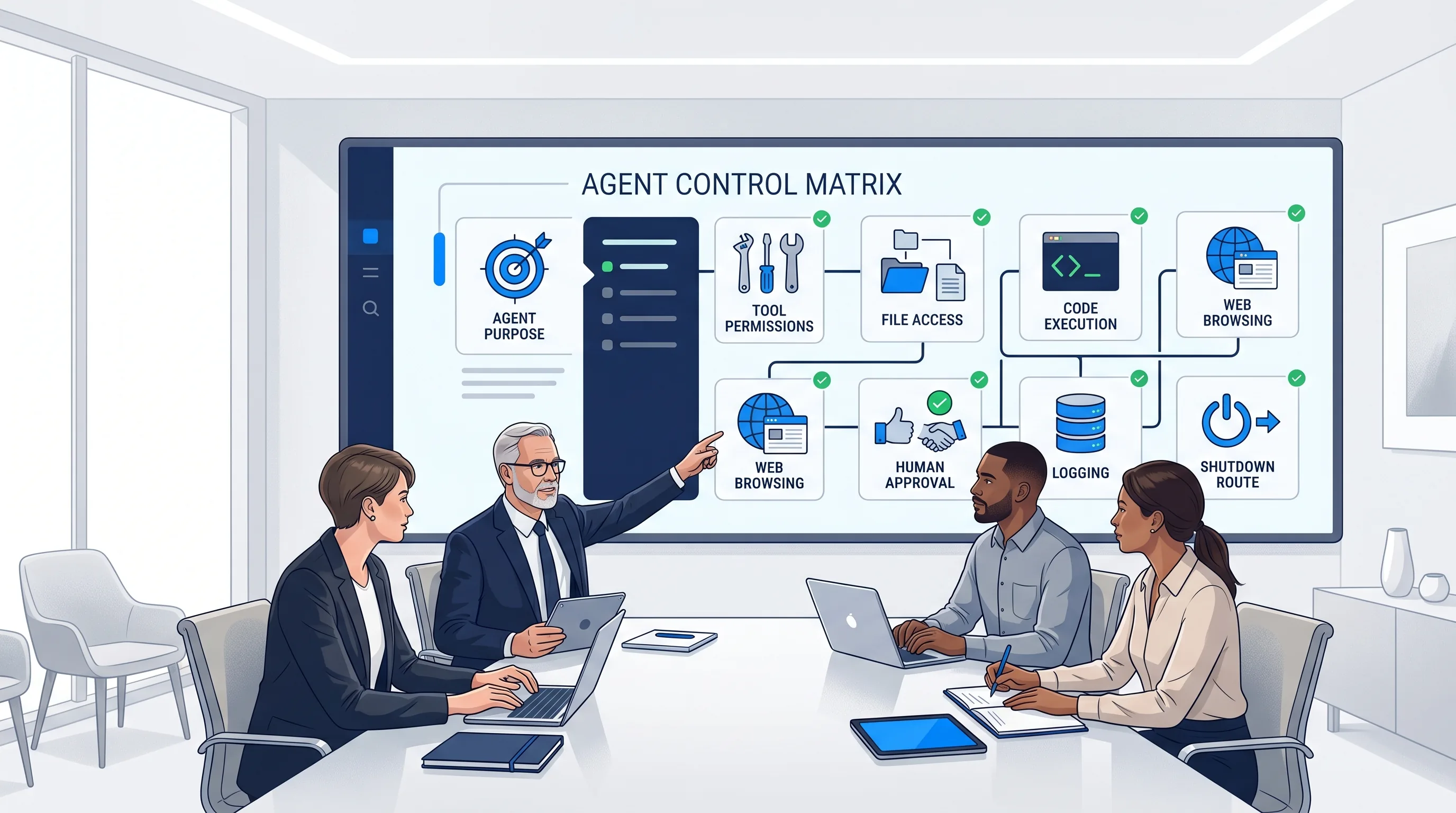
If an AI agent can call tools, read or write files, browse the web, execute code, or update systems, it needs a control matrix before wider rollout. The minimum evidence set is practical: purpose, owner, data access, tool permissions, code boundary, external actions, approval gate, logs, incident route, and shutdown owner.
The risk is not that managed agents exist. The risk is letting them operate with unclear permissions, unclear owners, unclear approval points, and no retained evidence when a buyer, customer, board, or security reviewer asks what the agent was allowed to do.
You are testing agents that reason, use tools, execute code, read or write files, or fetch live web data.
The agent may touch tickets, repositories, documents, customer records, sales data, support workflows, or internal approvals.
You need a practical record of what the agent may do, who approves it, where logs sit, and who can stop it.
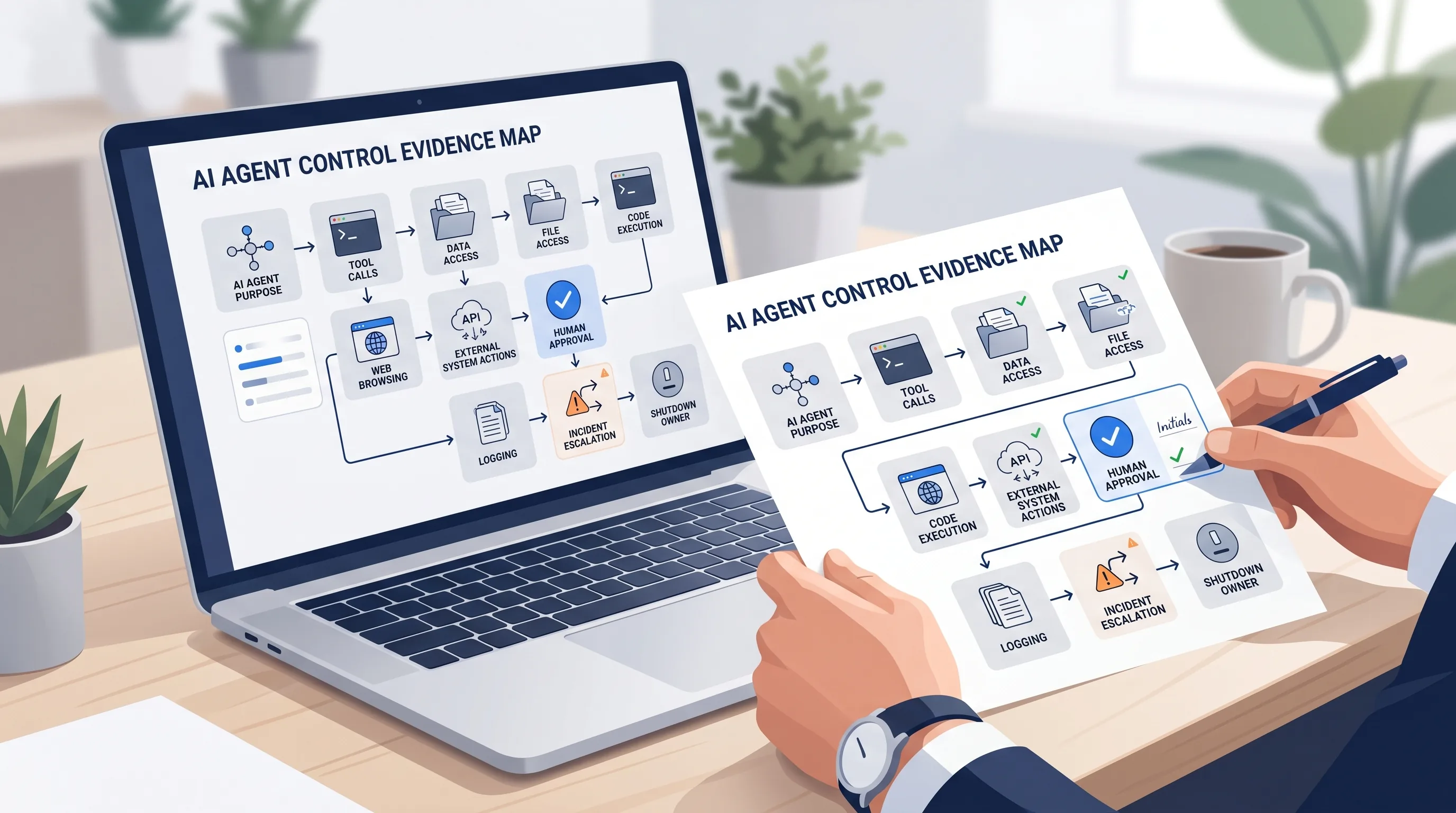
Select the control maturity for each row. Use Enforced with evidence only when the rule is implemented and someone can retrieve the record later.
Scoring rule: Missing = 0. Documented = 1. Enforced with evidence = 2. Maximum score = 24.
Start by changing each row from Missing to the state that matches the evidence you can actually retrieve.
Do not widen rollout until purpose, permissions, approval, logs, and shutdown evidence are documented.
| Agent control | Missing | Documented | Enforced with evidence |
|---|---|---|---|
| Agent purpose and scopeYou can describe what the agent is allowed to do and what outcome it supports. | |||
| Business ownerA named accountable owner approves the agent use case and accepts residual risk. | |||
| Data and file accessThe team knows what files, repositories, tickets, documents, or datasets the agent can read or write. | |||
| Tool and skill permissionsThe agent's tools, skills, APIs, and connectors are listed and reviewed before use. | |||
| Code execution boundaryCode execution is constrained, reviewed, and separated from production deployment authority. | |||
| Web browsing and external fetchThe team controls how the agent fetches, processes, and trusts external web content. | |||
| External system actionsRecord updates, ticket changes, emails, commits, deployments, or workflow actions require clear approval rules. | |||
| Human approval gateHigh-impact actions need a defined human approval point before execution or external release. | |||
| Agent identity and accessThe agent has controlled identity, least-privilege access, and no shared human credentials. | |||
| Logging and observabilityPrompts, tool calls, file changes, decisions, approvals, and errors have a known retention location. | |||
| Incident escalation and shutdownSomeone can stop the agent, revoke access, preserve evidence, and escalate if behavior is unsafe. | |||
| Versioning and change reviewAgent instructions, skills, permissions, and configuration changes are versioned and reviewed. |
This is a first-pass control signal, not a compliance score. It shows which agent controls have evidence and which still need work.
None yet.
None yet.
All controls.
Score: 0/24. Evidence enforced: none. Documented: none. Missing: all controls.
The rows are grouped around five practical questions. If one of these areas is weak, a managed agent can create work, change records, expose data, or leave too little evidence to reconstruct what happened.
Map the tools, files, code, web sources, connectors, and business systems the agent can reach.
Separate low-risk drafting from actions that change records, send messages, update tickets, or release content.
Check whether the agent can run code, write files, alter repositories, update systems, or trigger business actions.
Retain enough prompt, tool-call, output, file-change, approval, and incident evidence to review agent behavior later.
Assign the owner who can disable access, revoke tools, freeze changes, preserve logs, and run the escalation path when behavior becomes unsafe.
The matrix is a free triage tool. ACT and the Sprint are where thin rows become working governance records.
Use ACT-2 when managed agents need inventory, control mapping, approval evidence, incident route, board reporting, and buyer assurance.
Use the Sprint when agent permissions, ownership, logs, or system actions are unclear and leadership needs a defensible rollout path.
Use the matrix to find the gaps. Use ACT-2 or the Sprint to convert those gaps into editable implementation evidence.
This page is based on public Google and standards sources reviewed on 2026-05-23. It is intended as operational implementation guidance, not legal, audit, certification, procurement, or security assurance.
Last reviewed: 2026-05-23.
Public source basis: Google I/O 2026 announcements, Google Managed Agents announcement, Managed Agents API documentation, Gemini Enterprise Agent Platform overview, NIST AI RMF, and ISO/IEC 42001 public overview.
Move78 materials are informational and implementation-support resources only. They are not legal, tax, regulatory, audit, certification, conformity-assessment, procurement, or security advice.