Agent identity exposure diagnostic · browser-only scoring · no login · routes to ACT Tier 1 or ACT Tier 2 depending on severity
Agent identity and OAuth governance check

AI Agent Identity & OAuth Grant Exposure Check

Find out in under 4 minutes whether AI agents are running on governed identities or hidden OAuth grants.

3–4 minutes 12 scored questions No login

This is a governance visibility screen for AI-agent identities and OAuth-connected access paths. It is not an IAM platform, browser extension, or grant-monitoring product.

  • Screens inventory coverage, identity ownership, OAuth-grant visibility, scope discipline, logging quality, revocation readiness, and policy coverage.
  • Separates governed visibility from material blind spots before hidden access paths turn into an incident.
  • Routes cleanly into ACT Tier 1 for inventory and gap analysis, or ACT Tier 2 when policy, evidence, incident, and implementation controls are missing.
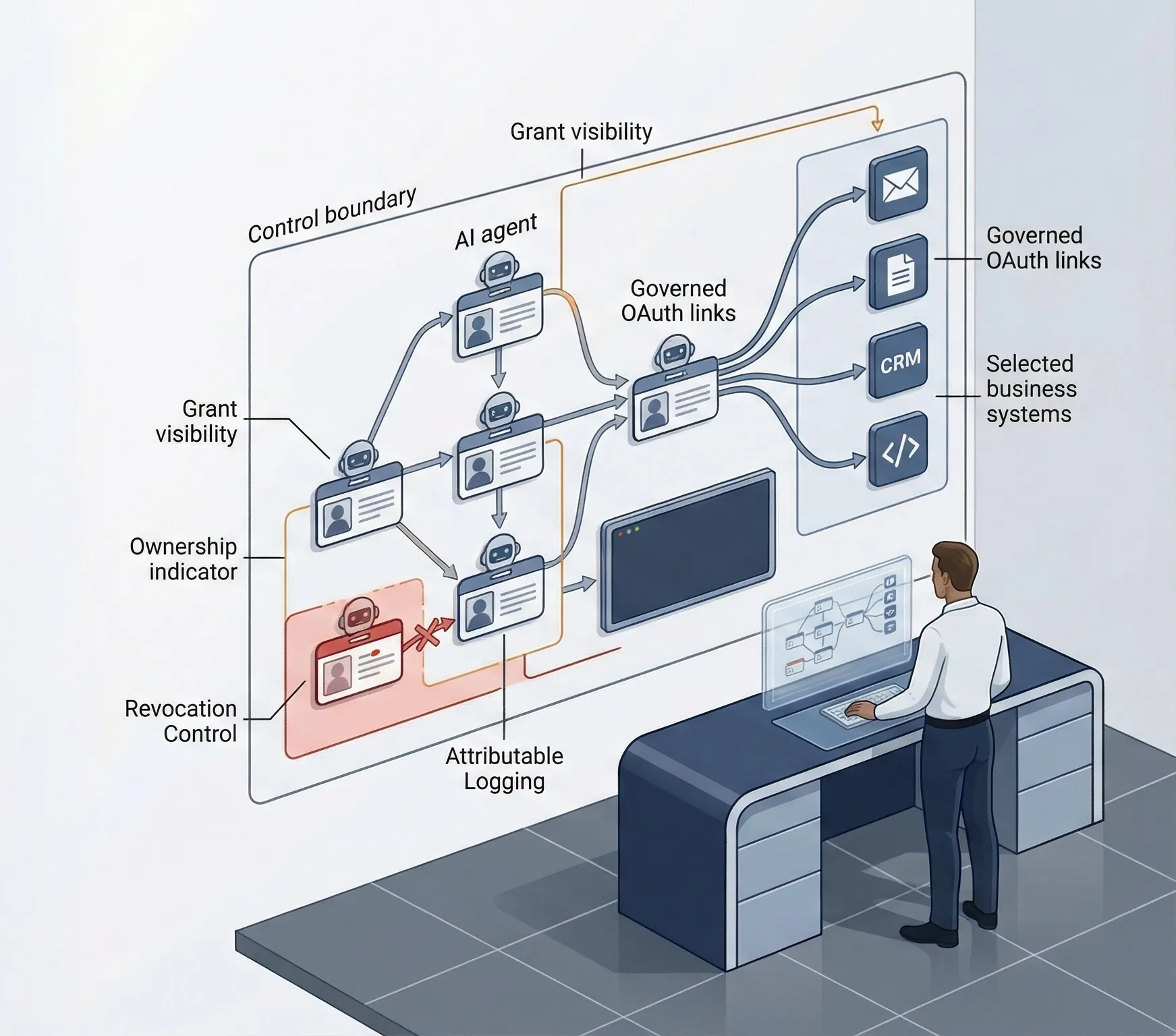
Enterprise AI agent identity governance scene showing controlled OAuth access, accountable non-human identities, revocation control, and audit visibility.
AI-agent identity governance across OAuth grants, ownership, scope control, revocation, and attributable logging.
Identity visibility

This screen classifies identity and OAuth exposure fast. It does not enumerate grants, export an inventory, or replace IAM tooling.

Interactive screen

Assessment

Use this to classify whether AI-agent identities and OAuth grants are visibly governed, partially governed, materially exposed, or effectively unmanaged.

Question 1 of 12 0% complete
Question 1 of 12

What this result should change

The purpose of this screen is to classify identity and grant exposure quickly, highlight the biggest visibility gaps, and route the organization to the correct next step without giving away the paid workbook or implementation layer.

What this tool evaluates about agent identities and OAuth grants

It evaluates whether AI-agent access is visible, attributable, governable, and revocable across inventories, grants, scopes, ownership, discovery, and policy coverage.

What a green result does not mean

A green result does not prove hidden grants are impossible. It means the current posture looks more governable than the other states and still needs discipline to stay that way.

Why the paid bridge changes by severity

Green and amber results usually need structured inventory, gap analysis, and dashboards first, which sit in ACT Tier 1. Severe red states need policy, evidence, incident, and implementation assets, which sit in ACT Tier 2.

Where to go next

Use the workbook bridge when the problem is visibility and cleanup. Use the implementation bridge when the result shows structural policy, ownership, incident, or evidence failures.

This page is informational only. It does not provide legal advice, compliance certification, or an audit conclusion.

AI Agent Identity & OAuth Grant Exposure Check FAQ

What does this tool evaluate about agent identities and OAuth grants?
It evaluates inventory coverage, identity model, OAuth-grant visibility, scope discipline, revocation readiness, attribution quality, ownership, policy coverage, and discovery discipline for AI-agent access paths.
Does a green result mean hidden grants are impossible?
No. It means the current posture appears more governable than the other states. Hidden grants can still emerge if discovery, recertification, or ownership discipline weakens.
Why are ownership and revocation weighted so heavily?
Because hidden OAuth access becomes materially harder to contain when nobody clearly owns the agent or grant and the organization cannot revoke access quickly during an incident.
Why does this tool route some results to ACT Tier 1 and others to ACT Tier 2?
Earlier-maturity results usually need visibility, inventory, and gap analysis first, which sit in ACT Tier 1. Severe red states need policy, incident, evidence, and implementation controls, which sit in ACT Tier 2 Professional.
Does this tool store anything I enter?
No. The assessment runs entirely in the browser. Answers are not stored, synced, or submitted to a server.