Answer first
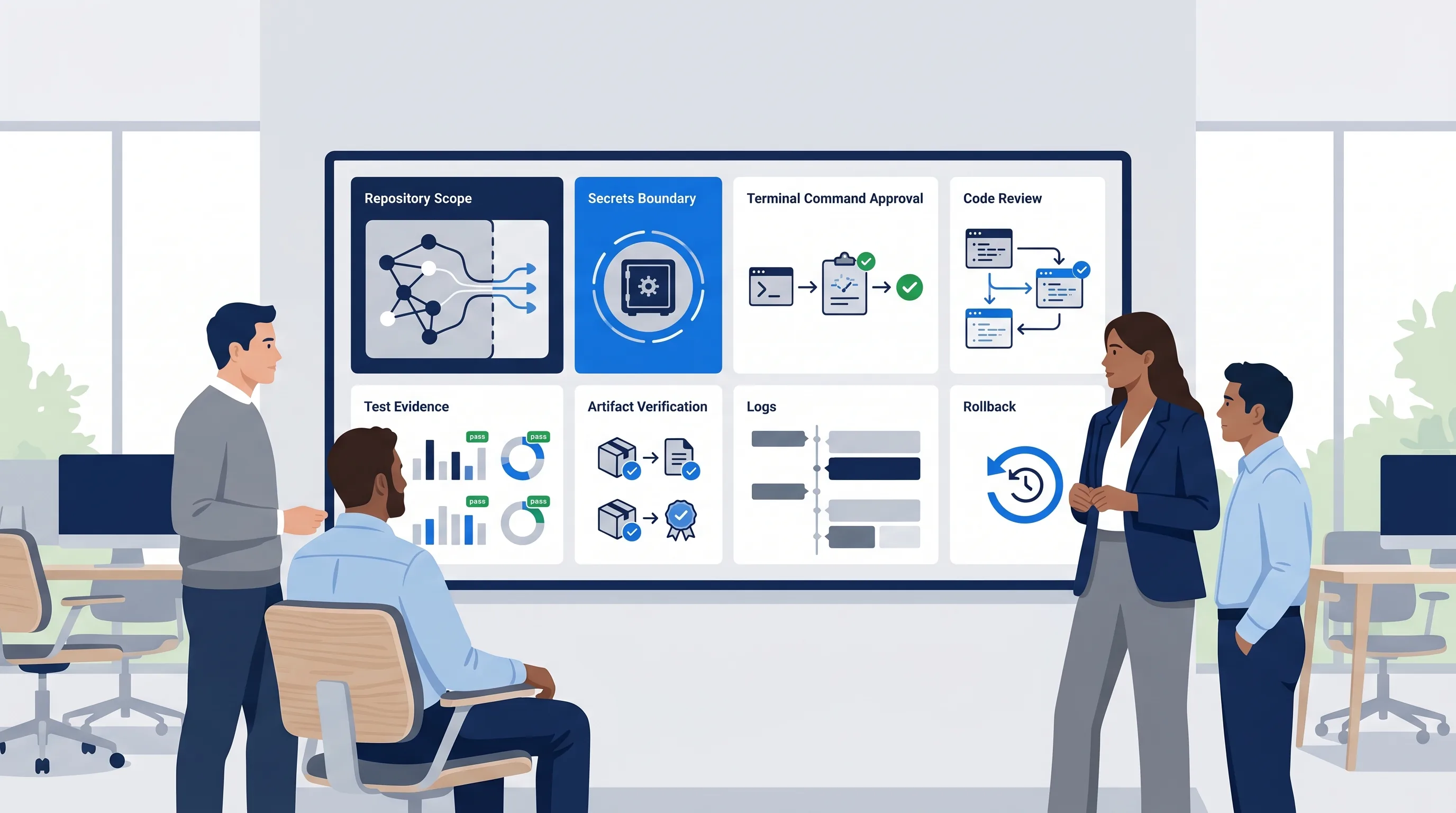
If an AI coding agent can read files, run commands, change code, call tools, or prepare pull requests, treat it as a development control surface. The minimum evidence set is simple: define the repository scope, protect secrets, constrain terminal execution, require human code review, keep test and artifact evidence, and preserve a rollback path.
The issue is not whether Antigravity makes development faster. The issue is whether a team can later explain what the agent touched, what it changed, what evidence was reviewed, and who approved the work before it reached a branch, build, or release path.
Use this checklist if one of these is true
AI can modify code
Your team is using agents that generate code, change files, propose pull requests, or operate inside a development environment.
Commands need boundaries
Agents or developers can trigger package installs, build steps, migrations, tests, shell commands, or cloud-connected actions.
You need retained proof
You need reviewable records for scope, secrets, dependency changes, code review, test evidence, logs, and rollback decisions.
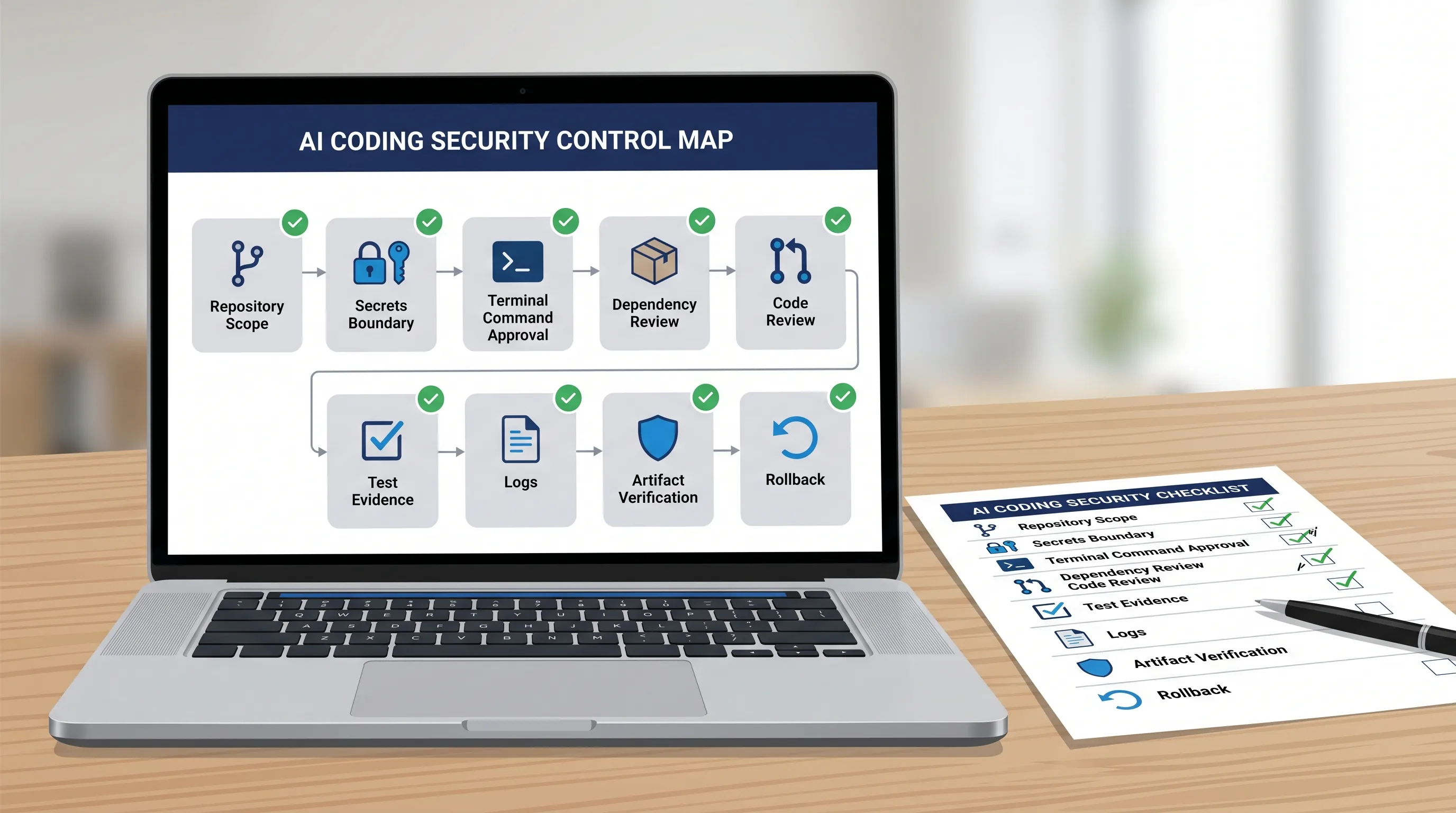
Antigravity agentic development security matrix
Select the maturity state for each control. Use Enforced only when there is retained evidence that the control is applied, not merely a team habit or verbal instruction.
Scoring rule: Missing = 0. Defined = 1. Enforced = 2. Maximum score = 24.
Your score
Not ready for agentic coding scale
Start by documenting what the agent may touch, execute, change, and commit before wider developer rollout.
Recommended route
Start with ACT-1 or the Google AI readiness checklist before enabling wider use.
| Security control | Missing | Defined | Enforced |
|---|---|---|---|
| Project and repository scopeThe repository, branch, task, and files in scope are written down before the agent starts work. | |||
| Secrets and credential boundaryThe agent cannot read, print, commit, or expose secrets, tokens, keys, environment files, or credentials. | |||
| Local file and workspace accessThe team defines what local folders, generated files, config files, and temporary artifacts the agent may touch. | |||
| Terminal and command executionShell commands, build steps, package installs, migrations, and destructive commands require a written boundary. | |||
| Dependency and package changesPackage updates, new libraries, lockfile changes, and transitive dependency changes are reviewed before merge. | |||
| Code change reviewA human reviewer checks generated code, tests, error handling, security impact, and maintainability before acceptance. | |||
| Test and build evidenceThe agent or developer keeps test results, build logs, screenshots, recordings, or other review artifacts. | |||
| Pull request and branch controlAgent-generated changes use reviewable branches, pull requests, commit messages, and reviewer assignment. | |||
| External connection boundaryBrowser use, web fetches, APIs, MCP servers, cloud projects, and third-party tools have explicit approval rules. | |||
| Artifact verificationScreenshots, plans, recordings, diffs, and logs are used to verify what the agent claims it changed. | |||
| Rollback and release separationThe team knows how to revert agent changes and keeps deployment separate from code generation. | |||
| Admin policy and observabilityAdmins can review access, usage, logs, policy settings, and who is allowed to use agentic development features. |
This is a first-pass development control signal. It is not a certification score, legal opinion, audit result, secure-code review, or security assurance.
Security control maturity
The visible buckets keep the page clean. The copy button still captures the full detailed result for your internal notes.
None yet.
None yet.
All controls.
Result summary will update when you change the control maturity in the matrix.
The five control areas that matter most
Agentic coding risk concentrates around a small number of control areas. Keep the public page simple, then use ACT-2 or a sprint to build the full internal evidence system.
What code and files can the agent touch?
Define the repository, branch, folder, task, and file boundary before the agent starts work.
What must the agent never read or expose?
Secrets, tokens, private keys, credentials, environment files, and customer data require explicit boundaries.
Which commands require approval?
Builds, migrations, package installs, destructive shell commands, and cloud-connected actions need review rules.
Who validates the code before merge?
Generated code still needs review for security, correctness, tests, maintainability, and dependency impact.
Can the team reverse unsafe agent changes?
Agent-generated changes should stay separate from release decisions. The team needs a rollback owner, revert path, and retained evidence.
Turn the checklist into working development evidence
The matrix identifies weak controls. The next step is to convert those gaps into artifacts that security, engineering, buyers, or auditors can inspect.
Google AI Readiness Matrix
Use this if the team has not yet mapped Google AI features, owners, data access, approvals, logs, and vendor evidence.
Managed Agents Matrix
Use this if agents can call tools, execute code, browse the web, read/write files, or act in managed environments.
ACT-2 or Sprint
Use ACT-2 or a sprint when agentic development controls must become reusable evidence, not one-off notes.
AI coding speed creates security debt if evidence is missing.
Use the matrix as a first screen. Use ACT-2 or an implementation sprint when repository, runtime, or release-path controls need to be formalized.
Source basis and limits
This page is based on public Google and standards sources reviewed on 2026-05-23. It is intended as operational implementation guidance, not legal, audit, certification, procurement, secure-code, or security assurance.
- Google I/O 2026 developer announcements were reviewed for Antigravity, Antigravity CLI, Antigravity SDK, Managed Agents, and AI Studio references.
- Google Cloud Gemini Code Assist documentation was reviewed for coding assistance, agentic chat, output-validation warning, and migration references.
- NIST AI RMF and ISO/IEC 42001 public materials were reviewed as general AI risk management and AI management system references.
- Move78 control wording is an implementation interpretation and must be reviewed by qualified engineering, security, privacy, legal, or compliance owners before use in production.