MCP credential governance diagnostic · browser-only scoring · no login · routes to ACT Tier 2 Professional
MCP credential governance check

MCP Credential & Scope Governance Check

Find out in under 4 minutes whether MCP servers are running on governable credentials and least-privilege scopes — or on broad, brittle, and poorly owned access.

3–4 minutes 12 scored questions No login

This is a governance screen for credential issuance, scope discipline, storage, rotation, revocation, and ownership across MCP-connected access paths. It is not a secrets scanner, not a gateway, and not a live token monitor.

  • Screens for shared tokens, human credential reuse, broad scopes, plaintext secret handling, weak rotation, and poor revocation readiness.
  • Separates bounded credential models from material access exposure before an MCP incident becomes a containment problem.
  • Routes directly to ACT Tier 2 because the missing value is implementation documentation, evidence, policy, and lifecycle control.
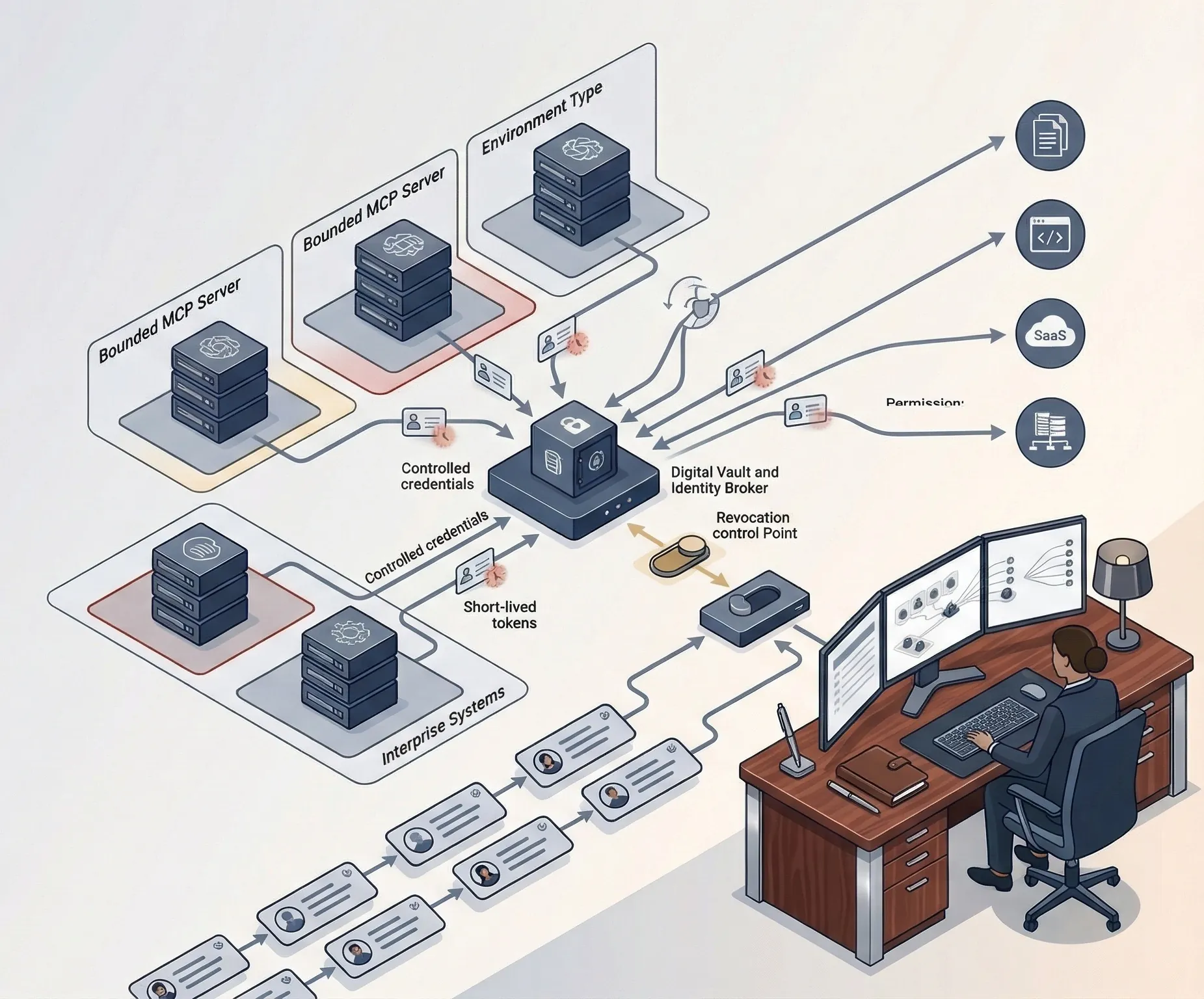
Enterprise MCP credential governance scene showing least privilege scopes, vault-backed secrets, environment separation, revocation controls, and attributable audit visibility.
MCP credential governance across least privilege, secret handling, rotation, revocation, and accountable access control.
Credential control

This screen classifies credential and scope governance fast. It does not inspect live tokens, collect configuration files, or export personalized remediation documents.

Interactive screen

Assessment

Use this to classify whether MCP credentials and scopes are tightly governed, partly governed, materially exposed, or fundamentally uncontrolled.

Question 1 of 12 0% complete
Question 1 of 12

What this result should change

The purpose of this screen is to classify credential and scope governance quickly, surface the biggest access-control weaknesses, and route the organization to the paid implementation layer without giving away the artifacts ACT is meant to sell.

What this tool evaluates about MCP credentials

It evaluates whether MCP-connected access is issued, scoped, stored, rotated, revoked, logged, reviewed, and owned in a way that can survive real scrutiny.

What a green result does not mean

A green result does not mean MCP is risk-free. It means the current credential model appears more governable than the other states and still needs discipline as scopes, tools, and users expand.

Why ACT Tier 2 is the paid bridge

This problem is not solved by another score. It is solved by policy, procedure, evidence, incident controls, and implementation ownership, which sit in ACT Tier 2 Professional.

Where to go next

Use the credential governance screen when approval is not enough and the real question is whether tokens, scopes, and revocation paths are defensible under pressure.

This page is informational only. It does not provide legal advice, compliance certification, or an audit conclusion.

MCP Credential & Scope Governance Check FAQ

What does this tool evaluate about MCP credentials and scopes?
It evaluates credential issuance, scope minimization, environment separation, secret storage, rotation, revocation, logging, approval discipline, ownership, and business impact for MCP-connected access paths.
Why are shared credentials and broad scopes weighted so heavily?
Because shared credentials and broad scopes make incidents harder to contain, reduce accountability, and expand the blast radius when an MCP server or token is abused.
Why does vault-backed storage matter if authentication already exists?
Authentication alone does not solve secret sprawl, plaintext storage, or long-lived credential exposure. Storage and lifecycle controls determine whether access remains governable over time.
Is this a secrets scanner or MCP gateway?
No. It is a governance triage tool. It does not scan repositories, inspect live tokens, or proxy MCP traffic.
Does this tool store anything I enter?
No. The assessment runs entirely in the browser. Answers are not stored, synced, or submitted to a server.