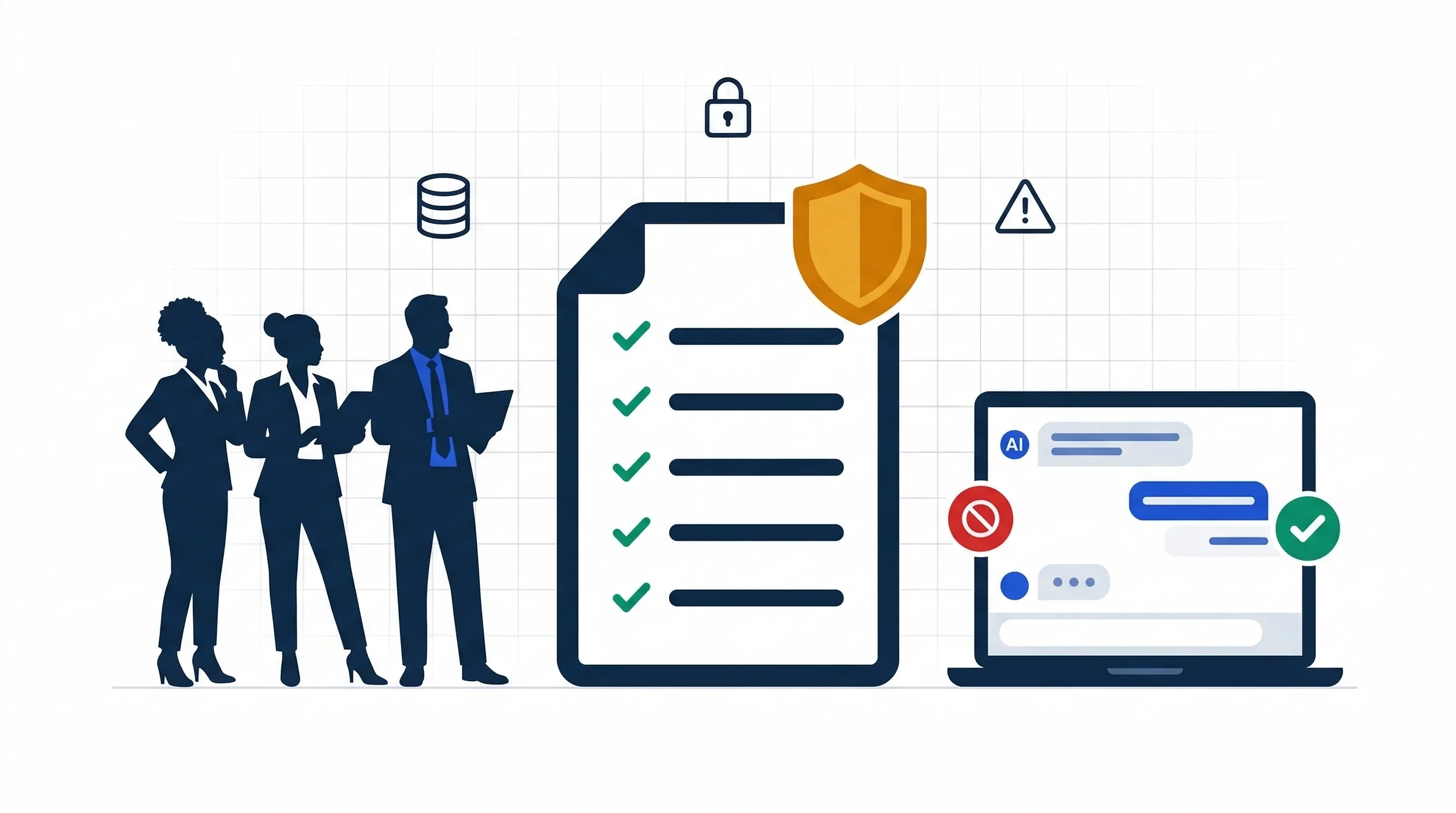
Why Your Organization Needs an AI Acceptable Use Policy Now
Here's a scenario that should keep compliance officers awake: an employee pastes three months of customer complaint data into ChatGPT to draft a summary report. They don't realize the dataset contains names, email addresses, and account numbers. The data is now sitting on OpenAI's servers, processed under their terms of service, outside your data processing agreements, and potentially in violation of GDPR, CCPA, or your contractual obligations to those customers.
That's not hypothetical. A CybSafe and National Cybersecurity Alliance study found that 38% of employees have shared confidential work data with AI tools without their employer's knowledge. Software AG's 2024 survey of 6,000 knowledge workers found 50% using unapproved AI tools at work. By late 2025, UpGuard reported over 80% of workers, including nearly 90% of security professionals, were using unapproved AI tools.
The problem isn't that employees are using AI. They should be. AI tools genuinely improve productivity for drafting, coding, analysis, and research. The problem is that they're using AI without guardrails, without data handling rules, and without any organizational awareness of what's happening. An AI acceptable use policy doesn't ban AI usage. It channels it into patterns that don't create compliance exposure.
Colorado SB26-189 was signed on 14 May 2026. It repeals and reenacts the prior SB24-205 framework with revised automated decision-making technology (ADMT) requirements, which begin on 1 January 2027. The EU AI Act is generally applicable from 2 August 2026, with Annex III high-risk rules from 2 December 2027 and Annex I product high-risk rules from 2 August 2028. An acceptable use policy is a governance tool, not proof that either law has been satisfied.
Browse available tools for available implementation resources. The previous assessment is unavailable.
What an AI Acceptable Use Policy Actually Does
An AI acceptable use policy does three things. First, it tells employees what they're allowed to do with AI tools. Without explicit permission, cautious employees won't use AI at all and miss productivity gains, while risk-tolerant employees will use AI for everything including tasks that create data exposure. The policy establishes the safe middle ground.
Second, it draws bright lines around what's prohibited. Processing personal data without approval, making automated decisions about people without human review, uploading confidential information to unapproved platforms. These aren't ambiguous judgment calls. They're hard rules that, if violated, create real regulatory and legal exposure. Employees need to know what those lines are before they cross them.
Third, it creates an organizational record that you've addressed AI governance at the employee behavior level. When an auditor asks "how do you ensure employees use AI responsibly?" or a regulator asks about your AI risk management practices, a deployed AUP with employee acknowledgment records is concrete evidence. Not sufficient evidence for full compliance, but a necessary starting artifact.
What it doesn't do is equally important. A one-page AUP doesn't replace an AI governance program. It doesn't satisfy ISO 42001 Clause 5.2's full AI policy requirements. It doesn't constitute the risk management policy required by C.R.S. 6-1-1702. It's the first artifact, not the only one. But it's the artifact you can deploy this week while the rest of the governance program catches up.
The Five Sections Every AI Policy Must Cover
The template follows a five-section structure. Each section answers a specific governance question that employees, auditors, and regulators will ask. Here's what they are and why the template handles them the way it does.
Section 1: Purpose and scope
This section answers "who does this policy apply to and what counts as an AI tool?" The template casts a deliberately wide net. It covers employees, contractors, and third parties. It defines AI tools to include chatbots, copilots, autonomous agents, and any system using ML or LLM capabilities. That breadth matters because scoping too narrowly creates loopholes. If your policy only mentions "ChatGPT," employees will reasonably argue that Claude, Gemini, or their CRM's built-in AI scoring doesn't count.
Section 2: Acceptable uses
This is the "permission" section, and it's more important than most organizations realize. Without explicit permission, you get one of two failure modes: employees avoid AI entirely (productivity loss), or they use it covertly (Shadow AI risk). The template permits drafting, code assistance, data analysis on non-sensitive data, and research. It also requires managerial awareness for any AI tool processing company data. That awareness requirement isn't about seeking approval for every ChatGPT query. It's about ensuring someone in the management chain knows which tools are being used so they can appear in the AI system inventory.
Section 3: Prohibited uses
These are the hard lines. Processing PII without privacy function approval. Automated decisions about people without human review. Uploading confidential data to unapproved platforms. Deploying autonomous agents without IT security review. Using AI outputs as professional advice without expert validation. Each prohibition maps to a real regulatory or legal risk. The PII restriction addresses GDPR and CCPA exposure. Human review should be designed for the use case and checked against applicable framework and legal requirements, including the revised Colorado ADMT law. The autonomous agent restriction catches the OpenClaw-style Shadow AI scenario from the inventory template.
Section 4: Data handling
This section creates the bridge between AI policy and data protection. Three rules: no sensitive data to AI tools without authorization, all external-facing AI outputs reviewed by a human, and all AI tools accessing company data must be registered in the inventory. That third rule is critical. It connects the AUP to the AI system inventory, creating a self-reinforcing governance cycle. Employees can't use an AI tool on company data unless it's in the inventory. The inventory can't be complete unless employees follow the AUP. Each artifact strengthens the other.
Section 5: Reporting and enforcement
A policy without enforcement is a suggestion. This section establishes three reporting obligations: report unauthorized AI usage, report data incidents involving AI tools, and report AI outputs that appear inaccurate or harmful. It ties enforcement to existing disciplinary procedures rather than creating a parallel system, which means you don't need to build new HR processes. It also establishes that intentional violations involving unauthorized data processing may trigger regulatory notification obligations. That's not a threat. It's a factual statement that strengthens the case for taking the policy seriously.
No login. No email. Word format, compatible with Microsoft Word 2016+, Google Docs, and LibreOffice Writer.
How to Deploy the Policy in Your Organization
Having a policy document isn't the same as having a deployed policy. Here's the practical sequence that turns a Word file into an enforceable governance artifact.
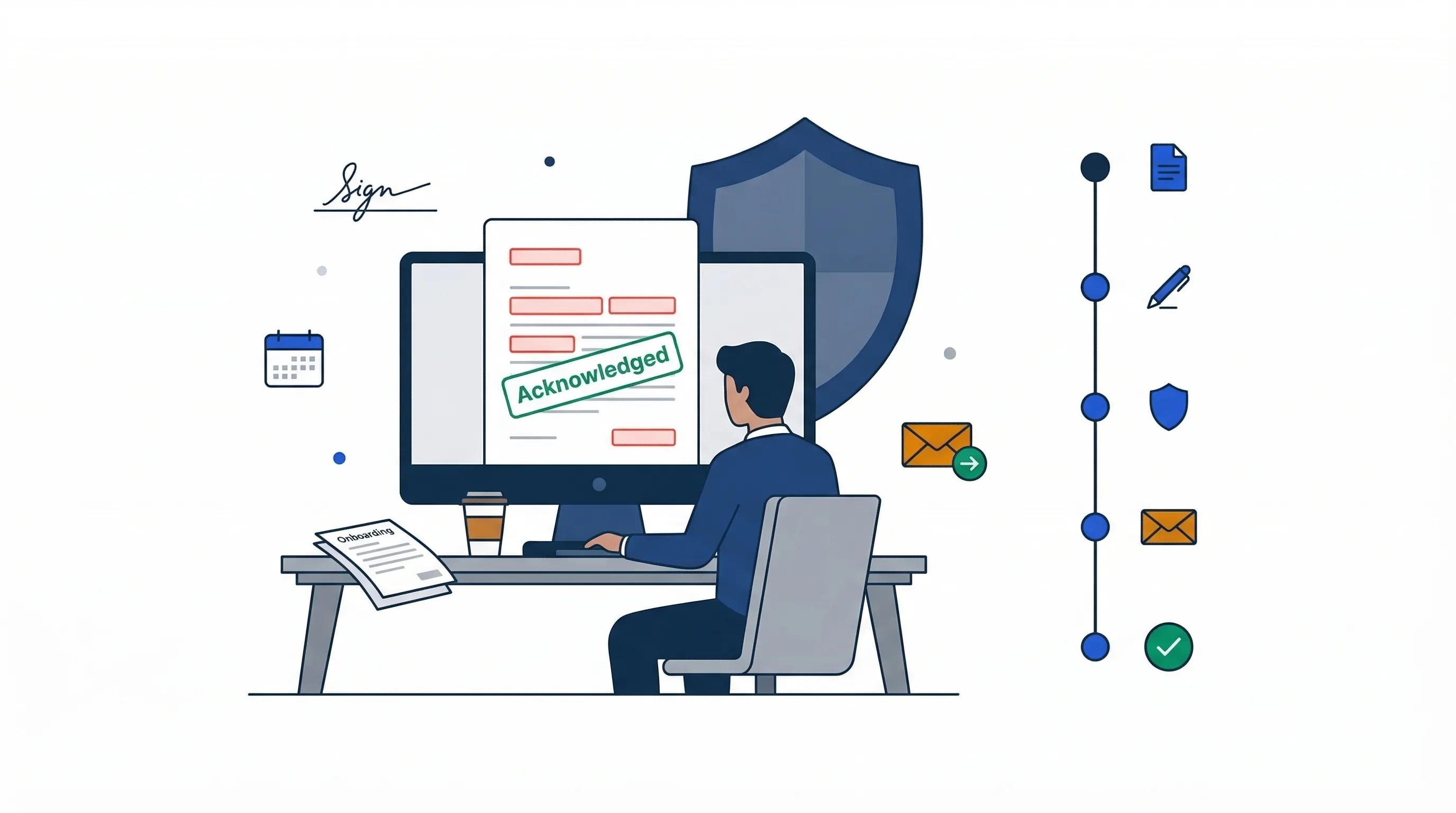
Step 1: Customize the placeholders. Replace every red [BRACKET] field with your organization's specific information. Don't skip the DPO/CISO contact details. Employees need to know exactly who to contact when they encounter an edge case, and "the compliance team" isn't specific enough.
Step 2: Legal review. Have your legal counsel review the customized policy. They'll flag anything that conflicts with your employment agreements, local labor laws, or industry-specific regulations. Healthcare organizations might need HIPAA-specific language. Financial services firms might need SOX or PCI-DSS references. The template is a starting point, not a finished product.
Step 3: Executive sign-off. The CISO, CTO, or a C-level executive needs to formally approve and sign the policy. This isn't bureaucratic theater. When an employee violates the policy and HR needs to act, executive sign-off provides the authority chain. It also demonstrates leadership commitment, which ISO 42001 Clause 5.1 explicitly requires.
Step 4: Distribute with acknowledgment. Email the policy to all personnel. Require a written or electronic acknowledgment of receipt. "I have read and understood the AI Acceptable Use Policy" with a signature and date. Store these acknowledgments. They're evidence artifacts that auditors and regulators will ask for.
Step 5: Include in onboarding. Add the AUP to your new hire onboarding materials. New employees should receive it alongside the employee handbook, code of conduct, and data protection policy. If someone joins the organization three months from now and nobody tells them about the AI policy, you've got a governance gap.
Read the Colorado guide for available implementation resources. The previous assessment is unavailable.
Common Mistakes That Make AI Policies Ineffective
The first mistake is making the policy too long. A 15-page AI governance policy with subsections on ethical principles, organizational values, and AI philosophy is impressive. Nobody reads it. The template is deliberately one page because a one-page policy that employees actually understand and follow is infinitely more useful than a comprehensive document that lives unread in a compliance folder.
Second mistake: banning AI outright. Some organizations react to Shadow AI by prohibiting all AI tool usage. That doesn't work. Software AG's data showed 48% of employees would continue using AI tools even if explicitly banned. A ban doesn't eliminate AI usage. It eliminates AI visibility. Every employee who ignores the ban becomes a Shadow AI risk that you can't monitor, can't inventory, and can't govern.
Third: making the policy too vague. "Use AI responsibly" isn't a policy. "Don't upload confidential data to unapproved AI platforms" is a policy. Employees need specific rules they can follow without interpreting ambiguous principles in real time. The template uses concrete language deliberately. If you abstract the prohibitions into general principles, you'll lose enforceability.
Fourth: deploying without training. Distributing a PDF isn't deployment. A 15-minute all-hands presentation explaining the policy, walking through three real scenarios (one acceptable, one prohibited, one edge case), and answering questions does more for compliance than a perfectly drafted document. Consider running the presentation quarterly for the first year as AI tooling evolves rapidly.
Fifth: never updating the policy. AI capabilities change fast. A policy written in March 2026 might not account for AI tools released in September 2026. Set a review cadence, at minimum annually, and add a trigger mechanism: review the policy whenever the organization adopts a new AI tool or a new AI regulation takes effect.
How This Connects to ISO 42001, NIST AI RMF, and Colorado
The template is framework-neutral by design. It doesn't reference ISO clauses, NIST functions, or Colorado statutory sections in the policy text itself. That's intentional. Employees don't need to know about Clause 5.2 or C.R.S. 6-1-1702. They need to know what they can and can't do with AI tools at work.
But the template aligns with framework requirements underneath. ISO 42001 Clause 5.2 requires an AI policy. Clause 7.3 requires awareness. The AUP addresses both. NIST AI RMF's GOVERN function expects documented policies for AI risk management. Colorado SB26-189 requires a separate current-law review. An AUP can support governance, but is not presented as a statutory requirement shared by all three frameworks.
The free template addresses employee-use rules. Other governance needs should be scoped separately. Confirm any required paid artifacts and mappings against the current ACT package file list before purchase. AI Controls Toolkit (ACT)
| Capability | Free AUP Template | AI Controls Starter ($399) |
|---|---|---|
| Employee AI usage rules (5-section AUP) | Yes | Yes (expanded 2-page AUP Lite) |
| Oversight committee structure | No | Yes |
| Cross-framework crosswalk (ISO + NIST + Colorado) | No | Yes |
| Incident response procedures | No | Yes |
| Gap analysis with severity ratings | No | Yes |
From Policy to Governance Program — What Comes Next
Deploying the AUP is step two in the governance sequence. Step one was the AI system inventory. Together, those two artifacts establish what AI systems you have and what rules employees follow when using them. That's a baseline, not a program.
Read the Colorado guide for available implementation resources. The previous assessment is unavailable.
The common thread across all three frameworks is that a basic AUP is necessary but not sufficient. ISO 42001 requires a complete AI Management System. Colorado SB26-189 replaces the former framework; its requirements need a separate review. NIST AI RMF expects governance, mapping, measurement, and management. The free template gives you the governance starting point. The AI Controls Toolkit (ACT) is a separate purchase; confirm any required artifacts and framework mappings against the current package before payment. AI Controls Toolkit (ACT)
Download the Free Template
The template is a Word document with four sections: Welcome and Instructions (how to customize and deploy), the AI Acceptable Use Policy itself (single page, five sections, red placeholders), Disclaimer and Legal (9-section terms of use), and Support (FAQs, resources, and contact information).
Format: .docx (Word). Compatibility: Microsoft Word 2016 and later, Google Docs, LibreOffice Writer. Customization: Replace all red [BRACKET] placeholders with your organization's details. Have legal counsel review before distribution.
No login. No email. No strings. See all free downloads from Move78